
Schools play a very important role in keeping children and young people safe. They have several legal duties placed upon them to ensure children are safe and their wellbeing is being looked after.
Schools should create a culture where:
- children feel confident to speak out if they have a concern about their own or another child’s safety
- adults feel confident to recognise and respond to safeguarding and child protection concerns.
This policy aims to support all school staff and volunteers
- To reduce risk and prevent harm to children.
- To ensure the identification of, and timely and appropriate responses to, risk and harm to children.
- To ensure that all adults in the school community understand their roles and responsibilities in respect of the above.
Weobley Schools’ federation provides a universal service to children in Herefordshire. School staff are closely involved, daily, with children and their families. We have a critically important role towards the identification and prevention of harm and abuse in all its forms including online.
This policy does not reiterate extensive sections of statutory guidance. It is a practical document that clarifies the roles and duties of all adults working in our schools and school communities. It should be used in conjunction with the most current version of Keeping Children Safe in Education and with related school policies, as specified in section 7 of this policy.
All staff have a personal and professional safeguarding responsibility, and as set out in statutory guidance (Appendix 1), it is our duty to maintain a professional working knowledge of relevant statutory guidance and of local arrangements as determined by Herefordshire Safeguarding Childrens Partnership.
- Safeguarding is the action that is taken to promote the welfare of children and protect them from harm. This applies to all children in our care and in our communities.
Safeguarding is everyone’s responsibility.
Safeguarding means:
- Providing help and support to meet the needs of children as soon as problems emerge
- Protecting children from maltreatment, whether that is within or outside the home, including online
- Preventing the impairment of children’s mental and physical health or development
- Ensuring that children grow up in circumstances consistent with the provision of safe and effective care
- Taking action to enable all children to have the best outcomes.
‘Child protection’ is the activity that is undertaken to protect specific children who are suspected to be suffering, or likely to suffer, significant harm. This includes harm that occurs inside or outside the home, including online. Therefore, protection is a specific element of safeguarding, whereas safeguarding legislation in general is about the promotion of children’s needs and the prevention of harm. This emphasises the need for all staff to be able to respond early when they have a concern rather than wait until this is more defined and certain.
At this point the involvement of services to protect the child (ren), including Children’s Social Care, is statutory. The critical message from legislation that should inform all actions and decisions is that “the child’s welfare is paramount” and consent is gained for the referral to be made if applicable to the situation.
- Executive Headteacher Weston Holder
- Head of Primary School Sharon Thomas
- Deputy Headteacher Russel Jones
- Designated Safeguarding Lead: Secondary School: Rachel Day Primary School: Sharon Thomas
- Deputy Designated Safeguarding Lead (s): Secondary school: Russel Jones and Joanne Davies Primary School: Sarah Wallace
- Designated Teacher for children who are Looked After (CLA) and Previously Looked After (PCLA)
- Secondary School: Sally Ann Richardson Primary School: Sarah Wallace
- Computing Lead/ Filtering software Manager: Dan Andrews
- Senior Mental Health Lead: Joanne Davies
- Safeguarding Link Governor: Jo Jones
West Midlands Child Protection and Safeguarding Procedures Manual
Herefordshire collaborates regionally with regards to child safeguarding procedures. Herefordshire’s local area multi-agency safeguarding arrangements are led by the statutory safeguarding partners/organisations: local authorities, integrated care boards and the police.
How to use the manual
Use this link to the contents page to access the different sections of the regional procedures: Statutory Child Protection Procedures; Regional Safeguarding Guidance; Local Area Specific Safeguarding Information and Procedures.
With respect to the Local Area Specific Safeguarding Information and Procedures, please choose Herefordshire from the drop-down list to access the localised content for your local partnership.
Child protection referrals
If you are a professional and want to make a referral to Children’s Social Care,
ReferralsCYPD@herefordshire.gov.uk
For details for Herefordshire Safeguarding Children Partnership, use https://westmids-herefordshire.trixonline.co.uk/chapter/reporting-concerns
Quick reference contact details for essential local services advice and support for referral and assessment:
- MASH: 01432 260800 (8:45am-5:15pm)
- EDT: Out of hours or at weekends: 01905 768020
- Early Help Hub: 01432 260261
West Mercia Police:
- If a child is in immediate danger, telephone 999 and request the Police
- To contact the police to discuss a child protection or safeguarding concern, when a child is not in immediate danger, telephone 101
- You can also email the police to inform them of concerns and start a conversation with them at Report a crime | West Mercia Police
The Local Authority Designated Officer (LADO)
If you are concerned that an adult working with children may have harmed a child, please refer the matter to the Head Teacher and then follow school policy to notify the LADO within 1 working day.
Telephone: 01432 261739
Radicalisation
If you believe someone is in danger of being exploited or becoming radicalised, use your organisation’s own safeguarding and duty of care procedures in the first instance to raise your concerns. Channel can then become involved if necessary.
Anyone can call the national police Prevent advice line on 0800 011 3764, in confidence, to share your concerns with specially trained officers. The advice line is open 9am to 5pm every day.
You can also contact the Prevent team by emailing
Or you can report a concern using the Prevent referral form.
If you are concerned about someone outside Herefordshire, for example, a student who doesn’t live in the county, you can still call one of the numbers above for advice.
Additional support for online abuse
Child Exploitation and Online Protection (CEOP) works to keep children safe from sexual abuse and grooming online. CEOP are unable to respond to reports about bullying, fake accounts, or account hacking. You can report to CEOP if you are concerned that a child is being sexually abused or groomed online. This might be from someone they know or someone they have only ever met online. CEOP are here to help and advise you and to make the child safe.
If you have already reported your concern to your local statutory service, including children’s social care or the police, you do not need to make a report to CEOP.
If you think a child is in immediate danger, please call the police on 999.
For more information relating to keeping children safe online from sexual exploitation and abuse you can visit our CEOP Education website for professionals.
- Keeping Children Safe in Education 2025
- Working together to Safeguard Children 2023
- UKCCIS guidance: Sexting in schools and Colleges, responding to incidents and safeguarding young people Sept 2016 Sharing nudes and semi-nudes: advice for education settings working with children and young people Dec 2020
- Safer working practice Feb 2022
- Section 175 of the Education Act 2002, which places a duty on schools and local authorities to safeguard and promote the welfare of students
- The School Staffing (England) Regulations 2009, which set out what must be recorded on the single central record and the requirement for at least one person on a school interview/appointment panel to be trained in safer recruitment techniques
- Part 3 of the schedule to the Education (Independent School Standards) Regulations 2014, which places a duty on academies and independent schools to safeguard and promote the welfare of students at the school
- The Children Act 1989 (and 2004 amendment), which provides a framework for the care and protection of children
- Section 5B(11) of the Female Genital Mutilation Act 2003, as inserted by section 74 of the Serious Crime Act 2015, which places a statutory duty on teachers to report to the police where they discover that female genital mutilation (FGM) appears to have been carried out on a girl under 18
- The Rehabilitation of Offenders Act 1974, which outlines when people with criminal convictions can work with children
- Schedule 4 of the Safeguarding Vulnerable Groups Act 2006, which defines what ‘regulated activity’ is in relation to children
- The Human Rights Act
- The Equality Act 2010
Thresholds Guidance – Herefordshire Safeguarding Boards and Partnerships
All staff should possess a working knowledge of the local levels of need thresholds guidance. Reference to this guidance will inform the identification of risk and harm.
Outline Levels of Need categories:
- Universal (Level 1) No additional support beyond that which is universally available.
- Early Help (Level 2) Children and young people where some concerns are emerging and who require additional support, usually from professionals already involved with them (Threshold to Consider Early Help Assessment EHA).
- Targeted Early Help (Level 3) Children and young people who are causing significant concern or where concerns recur frequently (Threshold to initiate EHA).
- Specialist (Level 4) Children and young people who are very vulnerable. (Threshold to refer to Children’s Social Care).
Early Intervention It is generally expected that referrals to children’s social care would follow significant input at levels 2 and 3.
The School Early Help Offer is published online and sets out the range of services and assistance that school provides for children and families.
Four key categories of abuse exist and several key aspects of each may be present at anyone time. It is the concern for the child that is important to recognise and report accordingly.
Child abuse is the maltreatment of a child by another person – by adults or children. Somebody may abuse or neglect a child by inflicting harm or failing to act to prevent harm. Abuse, including neglect, and other safeguarding issues are rarely standalone events that can be covered by one definition or label. In most cases, multiple issues will overlap. All referrals to children’s social care will be under one or more of these broad categories of abuse.
Physical abuse may involve hitting, shaking, throwing, poisoning, burning, or scalding, drowning, suffocating or otherwise causing physical harm to a child. Physical harm may also be caused when a parent or carer fabricates the symptoms of, or deliberately induces, illness in a child.
Emotional abuse is the persistent emotional maltreatment of a child such as to cause severe and adverse effects on the child’s emotional development. Some level of emotional abuse is involved in all types of maltreatment of a child, although it may occur alone.
Emotional abuse may involve:
- Conveying to a child that they are worthless or unloved, inadequate, or valued only insofar as they meet the needs of another person.
- Not giving the child opportunities to express their views, deliberately silencing them or ‘making fun’ of what they say or how they communicate.
- Age or developmentally inappropriate expectations being imposed on children. These may include interactions that are beyond a child’s developmental capability, as well as overprotection and limitation of exploration and learning, or preventing the child participating in normal social interaction.
- Seeing or hearing the ill-treatment of another.
- Serious bullying (including cyberbullying), causing children frequently to feel frightened or in danger, or the exploitation or corruption of children.
Sexual abuse involves forcing or enticing a child or young person to take part in sexual activities, not necessarily involving a high level of violence, whether or not the child is aware of what is happening. The activities may involve:
- Physical contact, including assault by penetration (for example rape or oral sex) or non – penetrative acts such as masturbation, kissing, rubbing, and touching outside of clothing.
- Non-contact activities, such as involving children in looking at, or in the production of, sexual images, watching sexual activities, encouraging children to behave in sexually inappropriate ways, or grooming a child in preparation for abuse (including via the internet).
- Sexual abuse is not solely perpetrated by adult males. Women can also commit acts of sexual abuse, as can other children.
Neglect is the persistent failure to meet a child’s basic physical and/or psychological needs, likely to result in the serious impairment of the child’s health or development. Neglect may occur during pregnancy as a result of maternal substance abuse. Once a child is born, neglect may involve a parent or carer failing to:
- Provide adequate food, clothing, and shelter (including exclusion from home or abandonment).
- Protect a child from physical and emotional harm or danger.
- Ensure adequate supervision (including the use of inadequate caregivers).
- Ensure access to appropriate medical care or treatment.
It may also include neglect of, or unresponsiveness to, a child’s basic emotional needs.
Herefordshire Council Child on Child abuse resource
Allegations of abuse made against other students
We recognise that children are capable of abusing other children. Abuse will never be tolerated or passed off as “banter”, “just having a laugh” or “part of growing up” as this can lead to a culture of unacceptable behaviours and an unsafe environment for students.
We also recognise the gendered nature of child-on-child abuse. However, all child-on-child abuse is unacceptable and will be taken seriously.
Most cases of students hurting other students will be dealt with under our school’s behaviour policy, but this child protection and safeguarding policy will apply to any allegations that raise safeguarding concerns. This might include where the alleged behaviour:
- Is serious, and potentially a criminal offence
- Could put students in the school at risk
- Is violent
- Involves students being forced to use drugs or alcohol
- Involves sexual exploitation, sexual abuse, or sexual harassment, such as indecent exposure, sexual assault, upskirting or sexually inappropriate pictures or videos (including the sharing of nudes or semi-nudes with or without permission).
Procedures for dealing with allegations of child-on-child abuse
Weobley Schools’ Federation will reassure victims that they are being taken seriously and that they will be supported and kept safe. A victim should never be given the impression that they are creating a problem by reporting abuse, sexual violence or sexual harassment. Nor should a victim ever be made to feel ashamed for making a report
If a student makes an allegation of abuse against another student:
You must record the allegation and tell the DSL, but do not investigate it.
- The DSL will contact the local authority children’s social care team and follow its advice, as well as the police if the allegation involves a potential criminal offence.
- Please refer to the Herefordshire policy document for further guidance and support
Creating a supportive environment in school and minimising the risk of child-on-child abuse
We recognise the importance of taking proactive action to minimise the risk of child-on- child abuse, and of creating a supportive environment where victims feel confident in reporting incidents.
To achieve this, we will:
- Challenge any form of derogatory or sexualised language or inappropriate behaviour between children, including requesting or sending sexual images
- Be vigilant to issues that particularly affect different genders – for example, sexualised or aggressive touching or grabbing towards female pupils, and initiation or hazing type violence that might impact, more typically, on boys
- Ensure our curriculum helps to educate students about appropriate behaviour and consent
- Ensure students are able to easily and confidently report abuse Ensure staff reassure victims that they are being taken seriously
We ensure staff are trained to understand:
- How to recognise the indicators and signs of child-on-child abuse, and know how to identify it and respond to reports
- That even if there are no reports of child-on-child abuse in school, it does not mean it is not happening – staff should maintain an attitude of “it could happen here”
- That if they have any concerns about a child’s welfare, they should act on them immediately rather than wait to be told, and that victims may not always make a direct report
- That certain children may face additional barriers to telling someone because of their vulnerability, disability, gender, ethnicity and/or sexual orientation
- That a student harming a child could be a sign that the child is being abused themselves, and that this would fall under the scope of this policy
- The important role they have to play in preventing child-on-child abuse and responding where they believe a child may be at risk from it
- That they should speak to the DSL if they have any concerns.
Radicalisation refers to the process by which a person comes to support terrorism and extremist ideologies associated with terrorist groups.
Extremism is vocal or active opposition to fundamental British values, such as democracy, the rule of law, individual liberty, and mutual respect and tolerance of different faiths and beliefs. This also includes calling for the death of members of the armed forces.
Terrorism is an action that: endangers or causes serious violence to a person/people; causes serious damage to property; or seriously interferes or disrupts an electronic system.
The use or threat of terrorism is designed to influence the government or to intimidate the public and is made for the purpose of advancing a political, religious or ideological cause.
Schools have a duty to prevent children from being drawn into terrorism. The DSL will undertake Prevent awareness training and make sure that staff have access to appropriate training to equip them to identify children at risk.
- We will assess the risk of children in our school being drawn into terrorism. This assessment will be based on an understanding of the potential risk in our local area, in collaboration with our local safeguarding partners and local police force.
- We will ensure that suitable internet filtering and monitoring is in place and equip our students to stay safe online at school and at home. (see appendix 5)
There is no single way of identifying an individual who is likely to be susceptible to an extremist ideology. Radicalisation can occur quickly or over a long period.
Staff will be alert to changes in students’ behaviour. Educate Against Hate provides useful resources to identify indicators of possible radicalisation. https://www.educateagainsthate.com
Recognise: It is important that everyone working with children should be able to recognise the signs of possible abuse and neglect. It is not adequate to wait for disclosure as the primary means of detecting child abuse. The recognition and identification of signs of potential abuse will form part of our continuous professional development.
Respond: All adults in school are ‘Trusted Adults’ and are emotionally available to children – a crucial aspect of our safeguarding culture. We will not ignore harmful behaviours or actions. We are prepared to respond appropriately to concerns and disclosures of abuse from children.
Record/Report: It is our duty to record first-hand, in writing, concerns and disclosures about children. This will be done promptly and securely using our safeguarding case management software CPOMS. All staff will be supplied with log-in details for CPOMS and are expected to make appropriate use of the system.
In cases of serious risk or harm to a child, an immediate verbal alert to the DSL is required. The DSL responds to and manages all actions, case notes and chronologies via CPOMS.
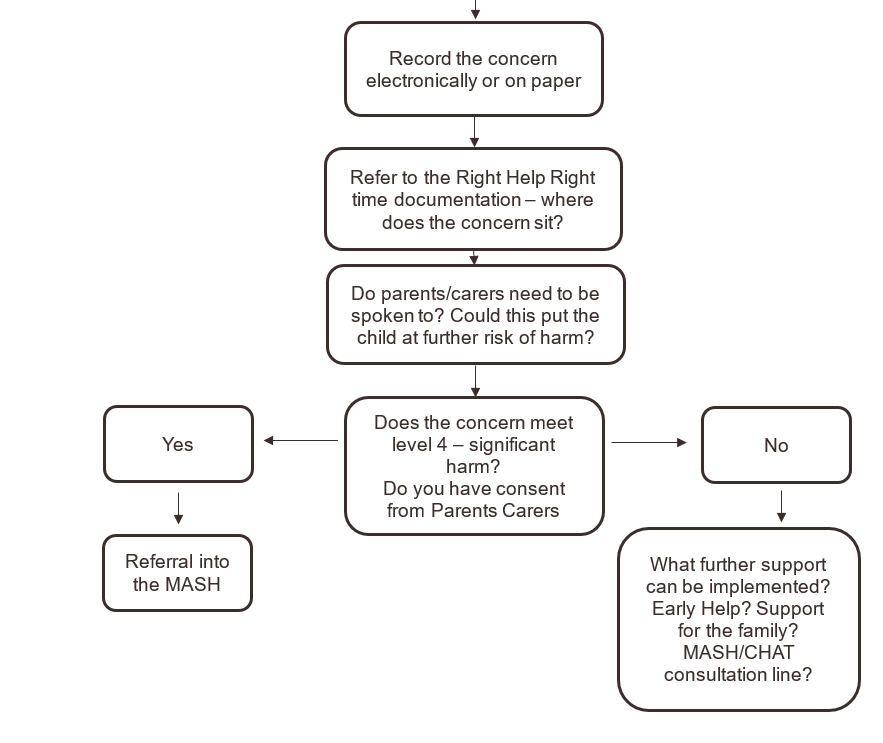
Refer: The DSL will triage all concerns promptly against levels of need thresholds guidance. In normal circumstances, the DSL will decide the most appropriate action. At Levels 3&4 this will normally be in consultation with the MASH team or CHAT team who will advise on next steps on the submission of a MARF to children’s social care.
Usually, the Designated Safeguarding Lead will determine the level of concern and refer to external agencies. In the absence of the DSL/DDSL, or if there is disagreement about levels of risk or harm, any staff member can make a referral to Children’s Social Care but should notify the DSL as soon as possible.
Female Genital Mutilation (FGM): Section 5B(11) of the Female Genital Mutilation Act 2003, as inserted by section 74 of the Serious Crime Act 2015, places a statutory duty on teachers to report to the police where they discover that female genital mutilation (FGM) appears to have been carried out on a girl under 18. This individual responsibility must not be delegated.
In the complex and evolving field of safeguarding, effective practice is best ensured through a programme of continuous professional development (CPD).
All staff members will receive input about safeguarding and child protection at induction. This will include:
- Current KCSiE guidance
- School Policies, including student behaviour
- The staff code of conduct
- Low Level Concerns policy
- Whistle-blowing procedures
- Online safety.
This is to ensure that staff understand the school’s safeguarding systems, their responsibilities, and can identify signs of possible abuse or neglect.
Professional learning will be continually updated and will:
- Be integrated, aligned and considered as part of the whole-school safeguarding approach and wider staff learning and curriculum planning
- Be in line with advice from the Local Safeguarding Children Partnership Have regard to the Teachers’ Standards to support the expectation that all teachers: Manage behaviour effectively to ensure a good and safe environment; Have a clear understanding of the needs of all students.
Staff will receive regular safeguarding and child protection updates (through emails, e-bulletins, and staff meetings) and enhanced by a planned Safeguarding CPD programme. Staff will receive annual safeguarding INSET and updates.
Volunteers will receive appropriate CPD, if applicable.
All staff receive appropriate training on the government’s anti-radicalisation strategy, Prevent, to enable them to identify children at risk of being drawn into terrorism and to challenge extremist ideas. Learning needs will be identified in accordance with local risk determined through regular Prevent risk assessments, at least every 3 years, unless more urgent need is apparent.
Wider societal factors beyond school
Staff receive regular input regarding contextual safeguarding (the areas of safeguarding specific to the location of the school). This information is enhanced by data of reported crime in our locality available online from West Mercia Police. Current local themes include:
- County Lines
- Rural isolation, neglect and poverty.
The DSL and Deputy DSLs will undertake appropriate child protection and safeguarding training (as set out in KCSiE 2025) at least every 2 years. In addition, they will update their knowledge and skills at regular intervals and at least annually (for example, through e-bulletins, meeting other DSLs, or taking time to read and digest safeguarding developments). They will also undertake Prevent awareness training.
All governors should regularly update learning about safeguarding to ensure they have the knowledge and information needed to perform their functions and understand their responsibilities i.e., support and challenge.
It is advisable for the link safeguarding member/governor to attend DSL level CPD every 2 years.
- All governors (in particular those on the curriculum committee) will ensure that the curriculum is delivered in such a way to include educating children about how to stay safe which will include Relationships and Sex Health Education (RSHE), online safety and broader safeguarding messages within PSHE. there are processes in place which enable children and young people to express their rights, wishes and feelings and provide feedback
Safer Recruitment – interview panels
At least one person conducting any interview for a post at the school will have undertaken safer recruitment training. This will cover, as a minimum, the contents of Keeping Children Safe in Education, and will be in line with local safeguarding procedures.
Staff who have pastoral contact with students and families will receive regular supervision which will provide them with support, coaching and training, promote the interests of children and allow for confidential discussions of sensitive issues.
Safeguarding and child protection is everyone’s responsibility. This policy applies to all staff, volunteers and governors in the school and is consistent with the procedures of Herefordshire Children’s Safeguarding Partnership. Our policy and procedures also apply to extended school and off-site activities and students who utilise alternative provisions.
All staff will read and understand part 1 and Annex B of the Department for Education’s statutory safeguarding guidance, Keeping Children Safe in Education, and review this guidance at least annually.
All staff will sign a declaration at the beginning of each academic year to say that they have reviewed the guidance and understand their professional duty to safeguard children and a record of this will be kept..
All staff will be aware of our systems which support safeguarding, including:
- this child protection and safeguarding policy,
- be aware that confidentiality can not be kept when a child has disclosed information that puts the child in danger or a crime has been committed
- the staff code of conduct the role and identity of the designated safeguarding lead (DSL) deputies,
- the behaviour and online safety polices including the use of Artificial Intelligence
- the safeguarding response to children who go missing from education.
- the Early Help process and their role in it, including: the identification of emerging problems, liaison with the DSL, and the sharing of information with other professionals to support early identification and assessment.
- the process for making referrals to local authority children’s social care and for statutory assessments that may follow a referral, including the role they might be expected to play
- what to do if they identify a safeguarding issue or a child tells them they are being abused or neglected, including specific issues such as FGM, forced marriage, exploitation and how to maintain an appropriate level of confidentiality while liaising with relevant professionals
- the signs of different types of abuse and neglect, as well as specific safeguarding issues, such as child on child abuse, child sexual exploitation (CSE), child criminal exploitation (CCE) indicators of being at risk from or involved with serious violent crime, FGM and radicalisation.
- the importance of reassuring victims that they are being taken seriously and that they will be supported and kept safe.
Is a member of the senior leadership team. The DSL takes lead responsibility for child protection and wider safeguarding.
During term time, the DSL will be available during school hours for staff to discuss any safeguarding concerns. Out of hours email contact;
Secondary school: safeguarding@weobleyhigh.co.uk
Primary school: safeguarding@weobleyprimary.co.uk
When the DSL is absent, the deputies will act as cover including out of hours and out of term activities.
The DSL will be given the time, funding, training, resources and support to:
- Provide advice and support to other staff on child welfare and child protection matters
- Take part in strategy discussions and inter-agency meetings and/or support other staff to do so
- Contribute to the assessment of children
- Refer suspected cases, as appropriate, to the relevant body (local authority children’s social care, Channel programme, Disclosure and Barring Service, and/or police), and support staff who make such referrals directly
- Report to the full board of Governors on an annual basis to update them on trends or specific issues to be addressed within the setting.
The DSL will also liaise with local authority MASH team regarding child protection concerns as appropriate. The full responsibilities of the DSL and deputies are set out in their job description and comply with Annex C (pg171) of KCSIE 2025
All School Governors will facilitate a whole-school approach to safeguarding, ensuring that safeguarding and child protection are at the forefront and underpin all relevant aspects of process and policy development. They will evaluate and approve this policy at each review, ensure it complies with the law and hold the Headteacher to account for its implementation. Governing bodies and proprietors should ensure that all governors and trustees receive appropriate safeguarding and child protection (including online) training at induction. This training should equip them with the knowledge to provide strategic challenge to test and assure themselves that the safeguarding policies and procedures in place in schools and colleges are effective and support the delivery of a robust whole school approach to safeguarding. Their training should be updated regularly.
- Governing bodies and proprietors should be aware of their obligations under the Human Rights Act 1998, the Equality Act 2010, (including the Public Sector Equality Duty), and their local multi-agency safeguarding arrangements.
Is responsible for the implementation of this policy, including: Ensuring that staff (including temporary staff) and volunteers:
- Are informed of our systems which support safeguarding, including this policy, as part of their induction
- Understand and follow the procedures included in this policy, particularly those concerning referrals of cases of suspected abuse and neglect
- Communicating this policy to parents when their child joins the school and via the school website
- Ensuring that the DSL has appropriate time, funding, training and resources, and that there is always adequate cover if the DSL is absent
- Ensuring that all staff undertake appropriate safeguarding and child protection training and update the content of this training regularly
- Acting as the ‘case manager’ in the event of an allegation of abuse made against another member of staff or volunteer, where appropriate (see appendix 3)
- Ensuring the relevant staffing ratios are met, where applicable (nursery)
- Making sure each child in the Early Years Foundation Stage is assigned a key person
Leaders must create a culture in which all staff and visitors understand how to raise concerns and feel supported to do so.
All Governors should ensure that they have a clear understanding of the local risks that are applicable to the demographic of the school.
All Governors should ask challenging questions of leaders’ assertions and ‘triangulate’ these assertions to assure themselves of the effective application of policies and procedures.
This policy is based on the Department for Education’s statutory guidance Keeping Children Safe in Education 2025, Working Together to Safeguard Children 2023, and the Governance Handbook. We comply with this guidance and the arrangements agreed and published by Herefordshire Safeguarding Children Partnership
This policy is also based on the following legislation:
- Section 157/175 of the Education Act 2002, which places a duty on schools and local authorities to safeguard and promote the welfare of students
- The School Staffing (England) Regulations 2009, which set out what must be recorded on the single central record and the requirement for at least one person conducting an interview to be trained in safer recruitment techniques
- Part 3 of the schedule to the Education (Independent School Standards) Regulations 2014, which places a duty on academies and independent schools to safeguard and promote the welfare of students at the school
- The Children Act 1989 (and 2004 amendment), which provides a framework for the care and protection of children
- Section 5B(11) of the Female Genital Mutilation Act 2003, as inserted by section 74 of the Serious Crime Act 2015, which places a statutory duty on teachers to report to the police where they discover that female genital mutilation (FGM) appears to have been carried out on a girl under 18
- Statutory guidance on FGM, which sets out responsibilities with regards to safeguarding and supporting girls affected by FGM
- The Rehabilitation of Offenders Act 1974, which outlines when people with criminal convictions can work with children
- Schedule 4 of the Safeguarding Vulnerable Groups Act 2006, which defines what ‘regulated activity’ is in relation to children
- Statutory guidance on the Prevent duty, which explains schools’ duties under the Counter- Terrorism and Security Act 2015 with respect to protecting people from the risk of radicalisation and extremism
- The Childcare (Disqualification) and Childcare (Early Years Provision Free of Charge) (Extended Entitlement) (Amendment) Regulations 2018 (referred to in this policy
- The “2018 Childcare Disqualification Regulations” and Childcare Act 2006, which set out who is disqualified from working with children.
This policy also meets requirements relating to safeguarding and welfare in the statutory framework for the Early Years Foundation Stage.
Some children have an increased risk of abuse, and additional barriers can exist for some children with respect to recognising or disclosing it. We are committed to anti- discriminatory practice and recognise children’s diverse circumstances. We ensure that all children have the same protection, regardless of any barriers they may face. We will ensure appropriate consideration of children who:
- Have special educational needs (SEN) or disabilities or health conditions
- Are young carers
- May experience discrimination due to their race, ethnicity, religion, gender identification or sexuality
- Have English as an additional language
- Are known to be living in difficult situations – for example, temporary accommodation or where there are issues such as substance abuse or domestic violence
- Are at risk of FGM, sexual exploitation, forced marriage, or radicalisation
- Are asylum seekers
- Are at risk due to either their own or a family member’s mental health needs
- Are looked after or previously looked after
- Are missing from education
- Whose parent/carer has expressed an intention to remove them from school to be home educated.
Annex B of KCSiE contains important additional information about specific forms of abuse and safeguarding issues. School and college leaders and those staff who work directly with children should read this annex.
- Should staff have any concerns about a child’s welfare, they should act on them immediately. They should follow their own organisation’s child protection policy and speak to the designated safeguarding lead (or deputy).
- Where a child is suffering, or is likely to suffer from harm, it is important that a referral to local authority children’s social care (and if appropriate the police) is made immediately.
This is a valuable supplement to our awareness of risk and harm and is available from the link below for frequent reference.
https://assets.publishing.service.gov.uk/media/686b94eefe1a249e937cbd2d/Keeping_children_safe_in_education_2025.pdf
- The Executive Headteacher, Designated Safeguarding Lead (DSL) and Deputy (DDSL) are aware of the requirement for children to have an appropriate adult when in contact with Police officers.
- PACE states that anyone who appears to be under 18, shall, in the absence of clear evidence that they are older, be treated as a child for these purposes.
- PACE also states that if at any time an officer has any reason to suspect that a person of any age may be vulnerable, then that person is entitled to be accompanied by an appropriate adult at any point.
- If a police officer arrives at the academy wishing to speak with a student, the receptionist will inform the principal and the DSL and follow the visitor’s policy. The DSL will ensure that arrangements are made to inform parents that this is the case and seek their presence at the academy as the appropriate adult. If for any reason the parent cannot attend to be an appropriate adult the DSL or Principal will ensure that an appropriate adult is provided from the academy leadership team.
- The DSL (or deputy) will communicate any vulnerabilities known by the school to any police officer who wishes to speak to a student about an offence they may suspect. This communication will be recorded on our online safeguarding system.
- If having been informed of the vulnerabilities, the DSL (or deputy) does not feel that the officer is acting in accordance with PACE, they will ask to speak with a supervisor or contact 101 to escalate their concerns immediately.
- A person whom there are grounds to suspect of an offence must be cautioned1 before questioned about an offence2, or asked further questions if the answers they provide the grounds for suspicion, or when put to them the suspect’s answers or silence, (i.e., failure or refusal to answer or answer satisfactorily) may be given in evidence to a court in a prosecution.
- A Police Officer must not caution a child or a vulnerable person unless the appropriate adult is present. If a child or a vulnerable person is cautioned in the absence of the appropriate adult, the caution must be repeated in the appropriate adult’s presence.
- The appropriate adult’ means, in the case of a child: the parent, guardian or, if the child is in the care of a local authority or voluntary organisation, a person representing that authority or organisation.
- a social worker of a local authority or, failing these, some other responsible adult aged 18 or over who is not:
- a police officer;
- employed by the police.
- under the direction or control of the chief officer of a police force; or
- a person who provides services under contractual arrangements (but without being employed by the chief officer of a police force), to assist that force in relation to the discharge of its chief officer’s functions.
Further information can be found in the Statutory guidance – PACE Code C 2019.
1 The police caution is: “You do not have to say anything. But it may harm your defence if you do not mention when questioned something which you later rely on in Court. Anything you do say may be given in evidence.”
2 A person need not be cautioned if questions are for other necessary purposes, e.g. (a) solely to establish their identity or ownership of any vehicle; to obtain information in accordance with any relevant statutory requirement; in furtherance of the proper and effective conduct of a search, e.g. to determine the need to search in the exercise of powers of stop and search or to seek co-operation while carrying out a search; or to seek verification of a written record.
Reviewed on: October 2024
By: Rachel Day & Stephen Warrell
Adopted by the Governing Body on: 9th October 2024
To be reviewed: October 2025